GET SUBGRAPH
The GET SUBGRAPH statement returns a subgraph that is generated by traversing a graph starting from a specified vertex. GET SUBGRAPH statements allow you to specify the number of steps and the type or direction of edges during the traversal.
Syntax
GET SUBGRAPH [WITH PROP] [<step_count> {STEP|STEPS}] FROM {<vid>, <vid>...}
[{IN | OUT | BOTH} <edge_type>, <edge_type>...]
[WHERE <expression> [AND <expression> ...]]
YIELD {[VERTICES AS <vertex_alias>] [,EDGES AS <edge_alias>]};
-
WITH PROPshows the properties. If not specified, the properties will be hidden. -
step_countspecifies the number of hops from the source vertices and returns the subgraph from 0 tostep_counthops. It must be a non-negative integer. Its default value is 1. -
vidspecifies the vertex IDs. -
edge_typespecifies the edge type. You can useIN,OUT, andBOTHto specify the traversal direction of the edge type. The default isBOTH. -
<WHERE clause>specifies the filter conditions for the traversal, which can be used with the boolean operatorAND. -
YIELDdefines the output that needs to be returned. You can return only vertices or edges. A column alias must be set.
The path type of GET SUBGRAPH is trail. Only vertices can be repeatedly visited in graph traversal. For more information, see Path.
Limitations
While using the WHERE clause in a GET SUBGRAPH statement, note the following restrictions:
- Only support the
ANDoperator. - Only support filter destination vertex, the vertex format must be
$$.tagName.propName. - Support filter edge, the edge format must be
edge_type.propName. - Support math functions, aggregate functions, string functions, datetime functions, type conversion functions and general functions in list functions.
- Not support aggregate functions, schema-related functions, conditional expression, predicate functions, geography function and user-defined functions.
Examples
The following graph is used as the sample.
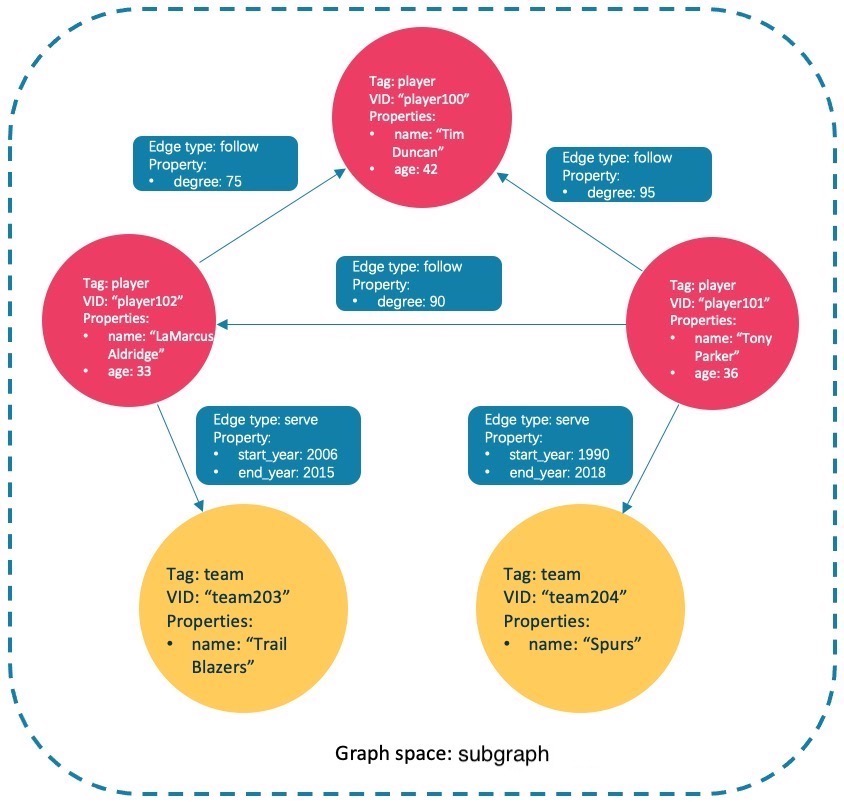
Insert the test data:
nebula> CREATE SPACE IF NOT EXISTS subgraph(partition_num=15, replica_factor=1, vid_type=fixed_string(30));
nebula> USE subgraph;
nebula> CREATE TAG IF NOT EXISTS player(name string, age int);
nebula> CREATE TAG IF NOT EXISTS team(name string);
nebula> CREATE EDGE IF NOT EXISTS follow(degree int);
nebula> CREATE EDGE IF NOT EXISTS serve(start_year int, end_year int);
nebula> INSERT VERTEX player(name, age) VALUES "player100":("Tim Duncan", 42);
nebula> INSERT VERTEX player(name, age) VALUES "player101":("Tony Parker", 36);
nebula> INSERT VERTEX player(name, age) VALUES "player102":("LaMarcus Aldridge", 33);
nebula> INSERT VERTEX team(name) VALUES "team203":("Trail Blazers"), "team204":("Spurs");
nebula> INSERT EDGE follow(degree) VALUES "player101" -> "player100":(95);
nebula> INSERT EDGE follow(degree) VALUES "player101" -> "player102":(90);
nebula> INSERT EDGE follow(degree) VALUES "player102" -> "player100":(75);
nebula> INSERT EDGE serve(start_year, end_year) VALUES "player101" -> "team204":(1999, 2018),"player102" -> "team203":(2006,  2015);
-
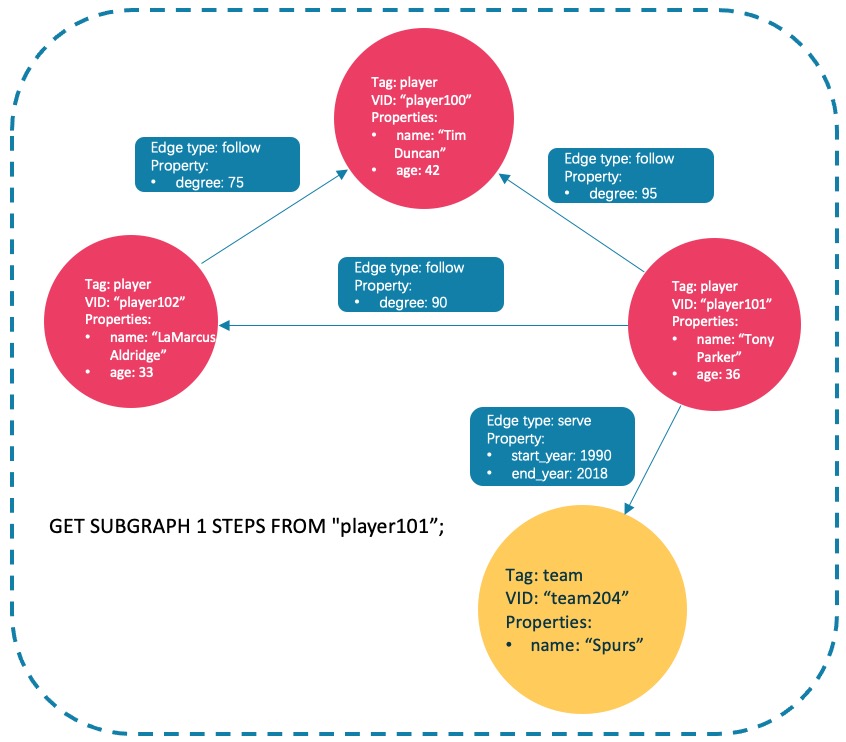
This example goes one step from the vertex
player101over all edge types and gets the subgraph.nebula> GET SUBGRAPH 1 STEPS FROM "player101" YIELD VERTICES AS nodes, EDGES AS relationships;+-------------------------------------------------------------------------+-----------------------------------------------------------------------------------------------------------------------------+| nodes | relationships |+-------------------------------------------------------------------------+-----------------------------------------------------------------------------------------------------------------------------+| [("player101" :player{})] | [[:serve "player101"->"team204" @0 {}], [:follow "player101"->"player100" @0 {}], [:follow "player101"->"player102" @0 {}]] || [("team204" :team{}), ("player100" :player{}), ("player102" :player{})] | [[:follow "player102"->"player100" @0 {}]] |+-------------------------------------------------------------------------+-----------------------------------------------------------------------------------------------------------------------------+The returned subgraph is as follows.
-
This example goes one step from the vertex
player101over incomingfollowedges and gets the subgraph.nebula> GET SUBGRAPH 1 STEPS FROM "player101" IN follow YIELD VERTICES AS nodes, EDGES AS relationships;+---------------------------+---------------+| nodes | relationships |+---------------------------+---------------+| [("player101" :player{})] | [] |+---------------------------+---------------+There is no incoming
followedge toplayer101, so only the vertexplayer101is returned. -
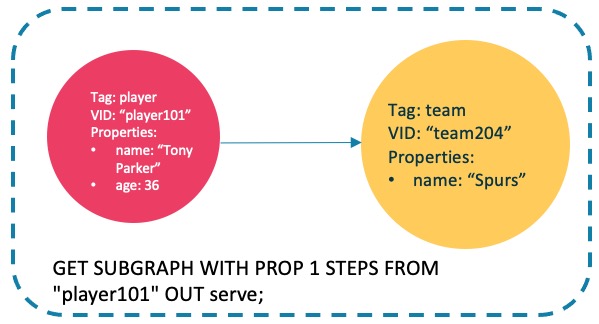
This example goes one step from the vertex
player101over outgoingserveedges, gets the subgraph, and shows the property of the edge.nebula> GET SUBGRAPH WITH PROP 1 STEPS FROM "player101" OUT serve YIELD VERTICES AS nodes, EDGES AS relationships;+-------------------------------------------------------+-------------------------------------------------------------------------+| nodes | relationships |+-------------------------------------------------------+-------------------------------------------------------------------------+| [("player101" :player{age: 36, name: "Tony Parker"})] | [[:serve "player101"->"team204" @0 {end_year: 2018, start_year: 1999}]] || [("team204" :team{name: "Spurs"})] | [] |+-------------------------------------------------------+-------------------------------------------------------------------------+The returned subgraph is as follows.
-
This example goes two steps from the vertex
player101overfollowedges, filters by degree > 90 and age > 30, and shows the properties of edges.nebula> GET SUBGRAPH WITH PROP 2 STEPS FROM "player101" \WHERE follow.degree > 90 AND $$.player.age > 30 \YIELD VERTICES AS nodes, EDGES AS relationships;+-------------------------------------------------------+------------------------------------------------------+| nodes | relationships |+-------------------------------------------------------+------------------------------------------------------+| [("player101" :player{age: 36, name: "Tony Parker"})] | [[:follow "player101"->"player100" @0 {degree: 95}]] || [("player100" :player{age: 42, name: "Tim Duncan"})] | [] |+-------------------------------------------------------+------------------------------------------------------+
FAQ
Why is the number of hops in the returned result greater than step_count?
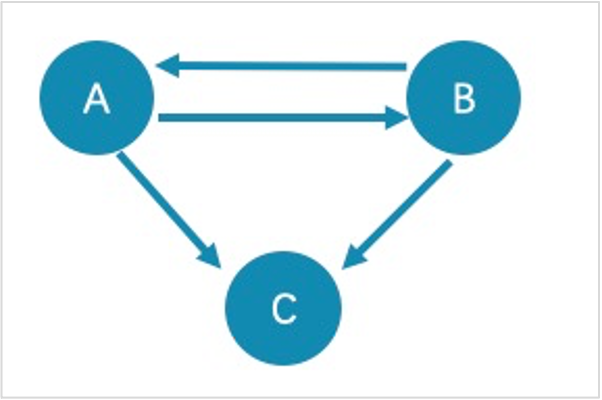
To show the completeness of the subgraph, an additional hop is made on all vertices that meet the conditions. The following graph is used as the sample.
-
The returned paths of
GET SUBGRAPH 1 STEPS FROM "A";areA->B,B->A, andA->C. To show the completeness of the subgraph, an additional hop is made on all vertices that meet the conditions, namelyB->C. -
The returned path of
GET SUBGRAPH 1 STEPS FROM "A" IN follow;isB->A. To show the completeness of the subgraph, an additional hop is made on all vertices that meet the conditions, namelyA->B.
If you only query paths or vertices that meet the conditions, we suggest you use MATCH or GO. The example is as follows.
nebula> MATCH p= (v:player) -- (v2) WHERE id(v)=="A" RETURN p;
nebula> GO 1 STEPS FROM "A" OVER follow YIELD src(edge),dst(edge);
Why is the number of hops in the returned result lower than step_count?
The query stops when there is not enough subgraph data and will not return the null value.
nebula> GET SUBGRAPH 100 STEPS FROM "player101" OUT follow YIELD VERTICES AS nodes, EDGES AS relationships;
+----------------------------------------------------+--------------------------------------------------------------------------------------+
| nodes                                              | relationships                                                                        |
+----------------------------------------------------+--------------------------------------------------------------------------------------+
| [("player101" :player{})]                          | [[:follow "player101"->"player100" @0 {}], [:follow "player101"->"player102" @0 {}]] |
| [("player100" :player{}), ("player102" :player{})] | [[:follow "player102"->"player100" @0 {}]]                                           |
+----------------------------------------------------+--------------------------------------------------------------------------------------+